Freedom the American Way: US
Marines kill 12 protesters in Mosul
|
|
|
Thanks - now get out ... an anti-American protest in
Baghdad. Photo: AFP |
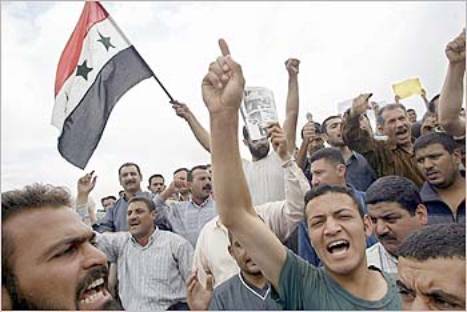
The shooting overshadowed the start of US-brokered talks aimed at sketching
out a post-Saddam Iraq.
At Mosul hospital Dr Ayad al-Ramadhani said the American soldiers had fired
into a crowd that was becoming increasingly hostile towards governor Mashaan
al-Juburi as he was making a pro-US speech in the city.
But a US miltary spokesman said the troops had come under fire from at least
two gunmen and fired back, but did not aim at the crowd.
"There are perhaps 100 wounded and 10 to 12 dead," Dr al-Ramadhani
said as angry relatives of the dead and wounded voiced hatred of Americans and
Westerners.
|
|
|
|
|
|
|
|
Bush
= Saddam |
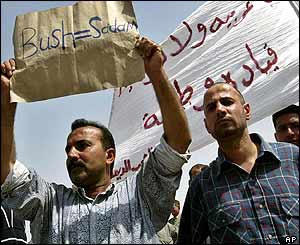
One witness, Marwan Mohammed, 50, said: "We were at the
market place near the government building, where Juburi was making a speech. He
said everything would be restored, water, electricity, and that democracy was
the Americans.
"As for the Americans, they were going through the crowd with their
flag. They placed themselves between the civilians and the building. The people
moved toward the government building, the children threw stones, the Americans
started firing. Then they prevented the people from recovering the
bodies."
A doctor, Said Altah, said: "Juburi said the people must co-operate
with the United States. The crowd called him a liar, and tempers rose as he
continued to talk. They threw objects at him, overturned his car, which
exploded. The wounded said Juburi asked the Americans to fire."
Ayad Hassun said the trouble broke out after the crowd interrupted Mr
Juburi's speech with cries of, "There is no God but God, and Muhammad is
his prophet."
"You are with Saddam's fedayeen," retorted Mr Juburi, to which the
crowd chanted that, "The only democracy is to make the Americans
leave."
He said 20 US soldiers escorted Mr Juburi back into the building. "They
climbed on top of the building and first fired at a building near the crowd,
with the glass falling on the civilians. People started to throw stones, then
the Americans fired at them."
But the US spokesman said: "There were protesters outside, 100 to 150,
there was fire, we returned fire. We didn't fire at the crowd, but at the top
of the building. There were at least two gunmen. I don't know if they were
killed. The firing was not intensive but sporadic, and lasted up to two
minutes."
At the US-sponsored talks near the southern city of Nasiriyah, crowds
earlier denounced the US presence in Iraq.
Thousands protested that they did not need US help now Saddam Hussein had gone.
"No to America. No to Saddam," chanted Iraqis from the Shia Muslim
majority oppressed by Saddam. Arabic television networks said up to 20,000
people marched.
In Baghdad, meanwhile, hundreds of people chanting "our blood and our
soul we give to Iraq" gathered outside the Palestine Hotel in protest
against the US presence. The hotel now houses US military and reporters.
Australia came in for criticism at the Nasiriyah conference when one
delegate, Sheik Sayed Jamaluddin, hit out at the detention of Iraqi asylum
seekers.
After thanking the US and Britain for liberating Iraqis from Saddam, the
Shiite cleric said: "I call on the representatives of the Australian
Government to ask the Government to accept the human rights of those Iraqis who
are held prisoner in some capacity in Iraq [viz] that they might be treated in
a humane fashion."
The talks ended on yesterday with an agreement to meet again in 10 days. Jay
Garner, the former US general leading the effort to rebuild Iraq, opened the
conference, saying: "A free and democratic Iraq will begin today."
In
bombed neighborhoods, everyone 'wants to kill Americans'
Knight Ridder
Newspapers
|
|
BAGHDAD, Iraq - In Baghdad's al Kharnouq
neighborhood, five unexploded American-made cluster bomblets perch precariously
in Qusai Abdel Majid's lemon tree and the flower bed beneath it. Stepping
carefully, one can follow a trail of dozens of the 2-inch-long black bombs that
have killed four of his neighbors so far.
"There was no military here to put the bombs on us. So, I imagine, they
wanted to kill us," said Abdel Majid, 43, who is afraid to let his
children play in the yard.
In the al Adhamiya neighborhood, men point to fallen walls, collapsed roofs
and smashed cars riddled with bullet holes. They speak swiftly and angrily.
"A year ago, on these streets, we would have yawned if someone had
mentioned America to us," Khalid Tarah said. "Now, look what they
have done to us. Everyone feels this pain. Everyone here now wants to kill. Everyone
here now wants to kill Americans."
At the end of the U.S. military's first week in Baghdad, gunfire of
uncertain origin continued sporadically throughout the day Tuesday, picking up
late at night, but looting had all but subsided. The Army's 101st Airborne
Division said it was considering an 11 p.m.-to-dawn curfew in an effort to
control the gunfire, but Marines who occupy the portions of Baghdad east of the
Tigris River said they had no such plan.
Elements of the 4th Infantry Division drove through town on their way from
Kuwait to northern Iraq, and were greeted by smiling and waving Baghdadis.
But many Baghdadis were angry as they talked about the destruction in their
neighborhoods.
"The people are paying for this war, not Saddam or anybody else.
Really, we wanted to get rid from him, but not in this way," said Kawther
Hussein, 46, a British-trained chemical engineer and mother of three who lives
in al Kharnouq.
"People lived here. Children lived here. Where will they live
now?" a man in al Adhamiya said as the crowd picked up the bricks of a
collapsed apartment building.
U.S. military officials acknowledge the damage in civilian neighborhoods.
Two U.S. Army ordnance experts went street to street in al Kharnouq on Tuesday
searching for the canisters that fluttered down April 7, leaving a virtual
minefield amid the rows of split-level homes of designs that mix Frank Lloyd
Wright and Mesopotamian inspirations.
"It's a big problem," said Army Corps of Engineers Capt. Thomas
Austin, whose crews are responsible for disarming unexploded ordinance in part
of Baghdad. "This is the worst neighborhood I've personally seen."
Austin defended the bomblets' use, saying the Iraqi military sometimes put
anti-aircraft artillery in civilian neighborhoods and that the bomblets were
meant to rain down on armor or anti-aircraft batteries, exploding when they hit
their metal surfaces.
Instead, they landed on softer targets - lawns and trees, and in one
instance the asbestos roof of 60-year-old Sabih el Bazzaz's carport -
cushioning their fall, and failing to trigger them.
Residents say the closest anti-aircraft battery was on a highway a
quarter-mile from their neighborhood. For them it is a sign that American
forces didn't distinguish between the military and civilians in their so-called
war of liberation.
The toll, they said, was four civilians. The house of Rashid Majid and his
sons Ghassan and Arkan had a black banner of mourning outside Tuesday,
declaring them "martyrs of the American aggression."
Around the corner, Uday al Shimarey's father said his son and the Majids
were all killed because they were curious about the bombs and apparently leaned
over to pick them up, or kicked them.
The view from al Adhamiya is just as bitter, though the U.S. bombing
campaign left it largely unscathed. At 5 a.m. last Thursday, residents awoke to
hear American tanks rolling down residential streets so narrow that a few got
stuck.
Thirty people were killed, though the circumstances were uncertain. Tarah
said they were "defending their homes ... hoping to keep away thieves and
robbers, when the tanks rolled in." He said a 10-year-old boy was shot as
he watched what was going on. Thirteen more were killed when they rushed to
protect Imam al Nawman Mosque nearby.
Sheik Moaied al Aadhamiy offered a tour of the mosque. There were large
holes in the four-story clock tower, caused by bombs, he said. The corners of
the two-story arched entryway had been ripped off by tank fire. The tomb of Imam
al Nawman is riddled with bullets holes, at least 20.
The sheik acknowledged that residents tried to drive the Americans away. But
the damage was done before. "There was no one here when the Americans
arrived," he said. "Those who came to defend the mosque arrived and
tried to drive them away, when they were killed. But the mosque was empty when
they did this."
Al Aadhamiy shook his head. The mosque is 1,020 years old, he said.
"I know the Americans said their war was with Saddam and not the Iraqi
people," he said. "But this is now inside our hearts and will never
leave. Each day when I come here, I have the same thought, everyone says the
same thing. There is no other reaction. We hate the Americans."
(Knight Ridder Newspapers correspondents Andrea Gerlin and John Sullivan
in Baghdad contributed to this report.)